Web app · Financial advisors
Praetorian
A white-label platform for financial advisory firms. Firm staff, advisors, and their clients each sign in under the firm's own brand, with AI agents that explain the numbers but never invent them.
Visit praetorian.finance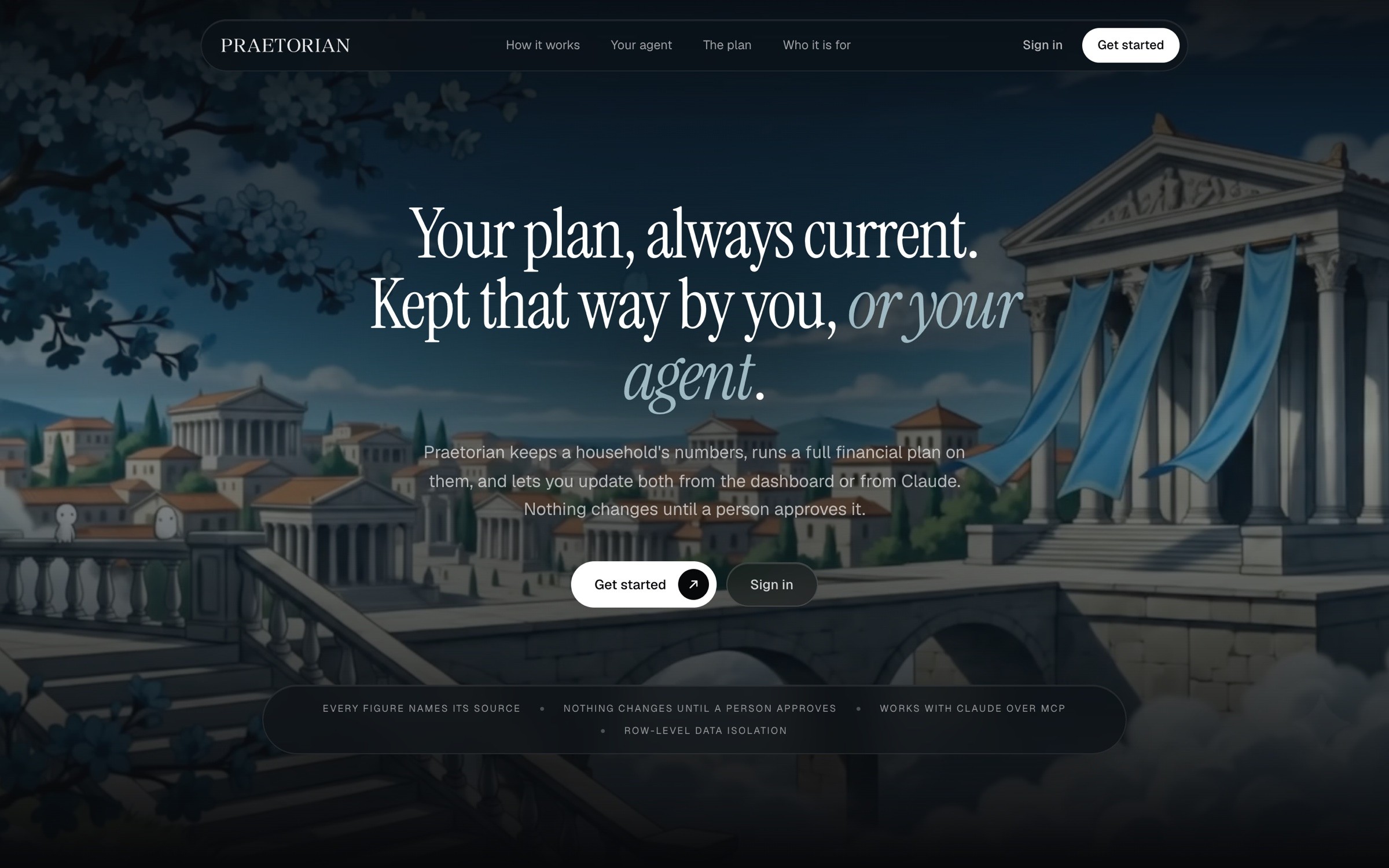
- Type
- Full stack app
- Started
- 2026
- What we did
- Product design, Front end, Backend, AI agents, MCP server
- Built with
- Next.js, TypeScript, Tailwind CSS, Supabase, Anthropic, Deepgram
An advisor's figures go stale between meetings. Praetorian keeps each household's numbers current. Changes come from the dashboard, from documents, from a meeting, or from an AI agent, and the advisor approves each one.
By the numbers
- Commits
- 613
- Database migrations
- 121
- Pages
- 63
- AI agents
- 2
Counted from the project's own repo on 2026-11-22.
One change to a household's numbers, end to end.
How one real job moves through the system, step by step, and which part of the system does each step.
- 01Many sources
A change arrives
From the dashboard, a client packet, a meeting transcript, or the client's own AI agent over MCP.
- 02Change set
It becomes a proposal
The change is saved as a proposed change set, not an edit.
- 03Planning engines
The engines compute
The engines work out every new figure. The model never does the math.
- 04Advisor
The advisor approves
Only a person can approve. Agents can propose, never approve or delete.
- 05Titus
The AI explains it
The next morning brief quotes the new numbers and explains them.
- 06Row-level security
Only the right people see it
The database decides which firm, advisor, and client can read each row.
What we designed.
The pages and pieces we drew and built for this project, from the first screen to the last.
- 01
A moving landscape
A full-screen looping video of rolling hills at dusk, and a share card that plays as video in iMessage, Slack, and Discord.
- 02
The advisor dashboard
The book of clients, readiness, calculators, meetings, plan documents, a compliance calendar, and reports.
- 03
Two AI agents
Titus writes the advisor's morning brief and runs calculators in chat. Jules answers plan participants. Both show as moving orbs.
- 04
The client portal
Goals, finances, projections, meetings, and files for each household.
- 05
A nine-step intake
A new client fills in one packet by link, and the figures go to the advisor to approve.
- 06
Meeting recorder
Record a meeting, get a transcript, and the figures from it come back as proposed changes.
Colors
- #07080a
- #9fb9c3
- #e4ebf0
- #85ac93
- #c2a878
Type
- Geist
- Instrument Serif
- Geist Mono
How it's built.
This one is more than a website. Here is the system behind it, and the choices that make it hold up.
The system
Screens
- Advisor dashboardThe book, meetings, reports, and compliance
- Client portalGoals, finances, and projections
- Intake packetNine steps, by link
Server
- Server actionsRun as the signed-in person
- MCP serverOAuth, for outside AI agents
- Planning enginesEvery figure is computed here
Data
- PostgresRow-level security on every table
- Change setsProposed, then approved
- Storage and VaultFiles and secrets
Outside services it calls
- AnthropicThe Titus and Jules agents
- DeepgramMeeting transcripts
- Google CalendarMeetings
- Form 5500 dataPublic plan filings
Choices that matter
- 01
The model never does the math
Engines compute every figure. The AI may only quote and explain them, so it can't make a number up.
- 02
Propose, then approve
Every change to a household's numbers is a change set the advisor approves, whether a person, a document, a meeting, or an agent sent it. Agents can't approve or delete.
- 03
A check on every table
One command rebuilds the whole schema in memory and fails if a table has no row-level security or a foreign key has no index.
Start a project
Want one like it?
Book a 30-minute call. We'll talk through the idea and tell you straight if we're the right studio to build it.
Or email ben@nashvillesoftwareco.com